
01 / Context
Two approaches. One requirement.
The project compared ring-oscillator and SRAM PUF designs in the context of a 16-bit microprocessor. Both approaches used circuit variation; their behavior under temperature change differed.
02 / Problem
An identity has to remain itself.
An identifier is not useful if it changes when the device warms up. The design needed both variation between devices and repeatability within a device.
03 / What I did
Compare the tradeoffs under changing conditions.
The ring-oscillator approach compared frequencies and used compensation, control logic and a settling interval to generate a value. The SRAM approach also explored compute-in-memory functionality, but stable cells were harder to obtain in the small design.
We compared the topologies through circuit simulation, Monte Carlo analysis and layout work. The final report discusses linking the PUF into the processor datapath through a custom instruction.
04 / What mattered
Dependability determined the choice.
The report favored the ring-oscillator approach for better temperature robustness in this design.
The report favored the ring-oscillator approach for this project. It traded generation time and control complexity for better temperature robustness. The SRAM design offered useful additional functionality, but its simulated yield was too low for the project's intended use.
05 / Reflection
Extra functionality cannot replace reliability.
Additional functionality could not compensate for an unreliable identifier. The deciding criterion was dependability under the conditions the project needed to tolerate.
06 / Selected evidence
The record behind
the work.
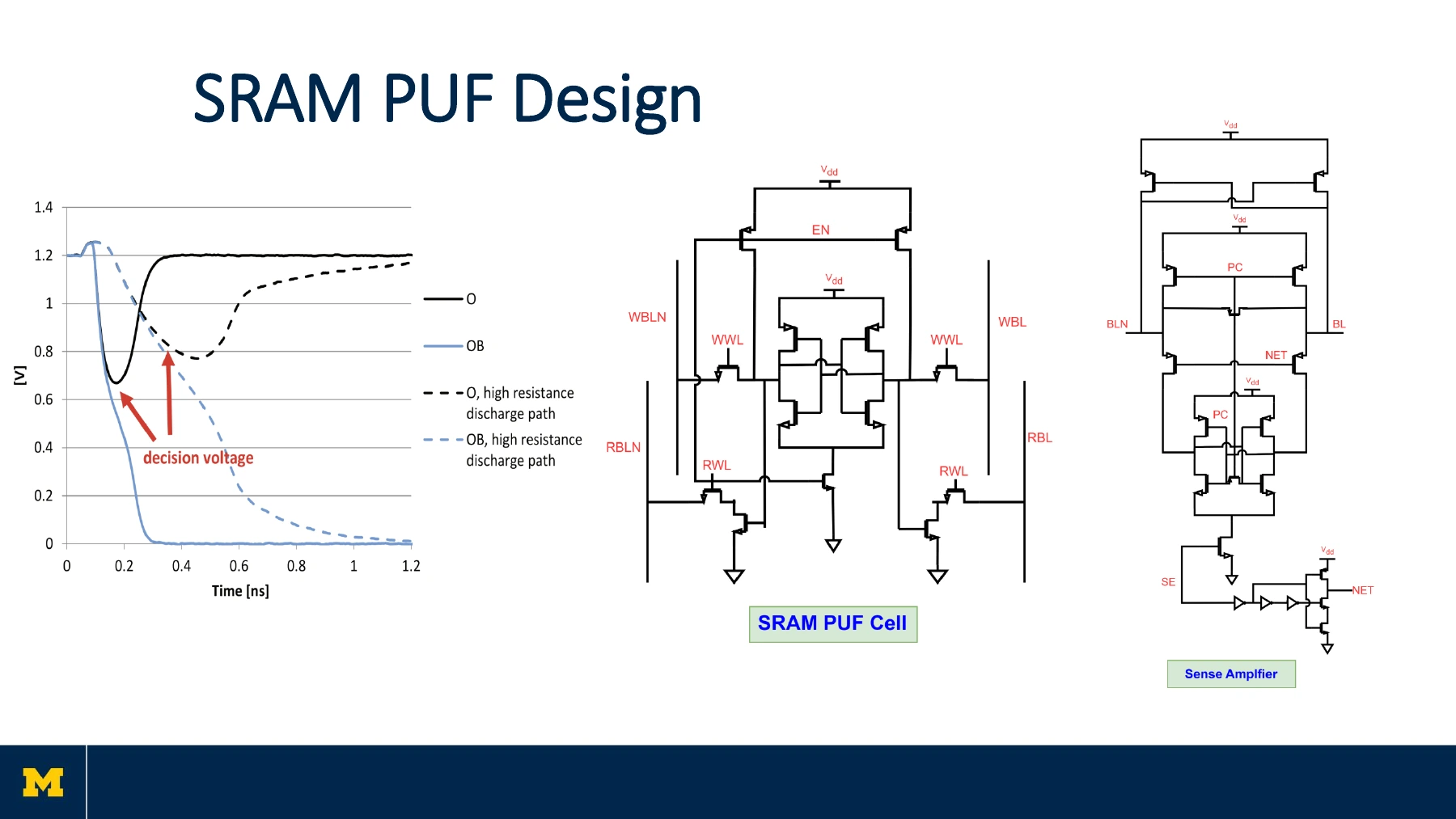
The report compares 95% ring-oscillator and approximately 10% SRAM yield in simulation. The presentation reports a different SRAM figure and area; these are separate source versions, not fabrication-yield claims.
Team / Yeshas Gowda, Rahul Narasimhegowda, Avinash Gupta, Bao Vo, Ali Hammoud and Alex Knowlton.